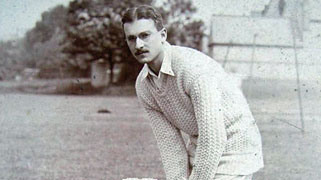
A year passes quickly. Too quickly. Peter Prendergast's death took us by surprise, ill health or not. Too young, before his time, so sudden. Despite the reality, I sometimes have forgotten that he is simply not with us anymore.

Every now and again, I reach for my phone to whisk off a pithy message before realising that the reply won't be forthcoming. It happened just a short time ago as Orla was pinging the ball around bringing the Blaze to another victory. I had to stop myself, I felt a bit of an idiot to be honest but reassured myself that that innings was being analysised from wherever her father was watching and we would be very much in agreement on the matter.
Similarly, I'm so tempted to exchange smart-arsed comments about the plight of our respective football teams - Spurs for me and West Ham for himself. It's all very strange. Over the years Peter used to send me pieces he had written, cricket, football and short stories. I kept the emails and it's lovely to delve in every now and then and hear that voice through his words.
As his anniversary approached, I did just that and found a piece dating back to 2017, which I do not believe was published on CricketEurope. With the consent of his family, it seems an appropriate time to remember an old friend through his wise, funny and irreverent words.
DV
A Team Game? By Peter Prendergast
A couple of years back I got a call from one of my kids and he was outraged, absolutely spitting, because he was down to bat at Number 10, yes 10, if I could believe that. Never mind the fact he was an Under 15 playing in an Under 17 game. Or that he was a relative beginner having taken up the sport a little more than a year previous. He was boiling at the injustice of it, absolutely steaming, when all of a sudden there’s a cheer in the background and he says, Great, someone’s out. At least that’s one of them out of the way.
It made me laugh.
He had learned plenty in his first year of organised cricket. His bowling still needed plenty of work but he could hit the ball hard and he was quick between the wickets. What he had yet to learn was how to disguise his true feelings.
It brought me back. Because I was the same growing up. Of course I was. The sooner my team mates were dismissed, the sooner I would be allowed to bat. It was a very simple equation. My head on the pillow the previous night, I would dream of playing a stylish match winning innings and as soon as I reached the ground the first obstacle in my way was all those team mates ahead of me in the batting order. And God knows there was enough of them. It was only as soon as they were dispatched that I could turn my attention to the next set of problems – the bowlers and the wicket and the match situation.
I played cricket because I wanted to bat and to bowl, not because I wanted to sit on a bench and applaud my teammates.
Unlike my son, though, I had learned to hide it. Good luck, guys, I’d wish the two openers on the way out. Loads of time, remember. Shot, Oscar! I’d shout from the touchline but really I’d be thinking why don’t you have a dirty slog and get out, Oscar, I’m growing old here watching you. That was the simple truth of it. It didn’t matter who you were; if you were ahead of me in the batting order, I wanted you gone. The ball hit in the air and it was always the same thing running through my mind, catch it, catch it, catch it, oh you stupid prick, how’d you drop that? Make ‘em pay, Oscar, make ‘em pay. Loads of time. Nothing rash now.
Save ‘em, that’s what the kids shout now which means save those legs so you can bat longer. Save ‘em, my ass. Run yourself to exhaustion and whack one in the air, is more like it.
Or Half way there, that’s another one. Oscar makes it to fifty and his old man nearly pulls a shoulder muscle he’s clapping so hard and then he shouts, Great stuff, Oscar but the job’s only half done. Like hell it is! You’ve already overstayed your welcome, Oscar, now get the fuck out and let the rest of us bat.
Nowadays some coaches insist that the kids sit like a row of milk bottles on a bench. Can you believe that? Sit there and make plenty of noise and encourage the batsmen, that’s the instruction. Encourage? Are you kidding me? I’m the one needs encouragement, stuck down at Number 9 every week. No wonder so many kids give up cricket early. When I was a kid I certainly didn’t sit on a bench and encourage anyone. As soon as I could persuade someone to accompany me I’d be down in the nets playing stump tests and wishing ill on my team mates until I’d let a silent cheer and go barrelling off to stick on the pads myself. I had come here to play, not to watch Oscar compile a patient and resourceful fifty. If I wasn’t getting an opportunity to play out in the middle I was damn well going to play in the nets.

And here’s the truth of the matter: As for the result of the actual game, I couldn’t have given a flying shit who won or lost. Nothing could have been of less interest to me.
Maybe the star players did. Maybe knowing that they would definitely get to bat and bowl this was a luxury they could afford. But I doubt it. They always seemed the most selfish of all. Get caught in a mid wicket mix up with one of these guys and you’ll soon find yourself flat on your back with studmarks on your sternum. That’s the truth of it. Anyhow, for the rest of us it was dog eat dog, all vying for prime spots in the batting order and for overs to bowl.
And how could it be otherwise? In what other sport could a gang of kids be expected to wait on the touchline for an opportunity to take the field and even shine and not to wish for that moment to arrive more quickly. It goes against every basic human and sporting instinct. Eleven year olds, I would hope, are generally bursting to get out onto that pitch, to bat and to bowl and to take stunning catches in the deep. They should want every ball to come to them. If a kid is ever going to be any good as a sportsman he will need confidence and courage and a hunger to learn. And he’s not going to learn a damn thing sitting on a bench clapping Oscar, that’s for sure. And he knows it. He doesn’t care how quick that bowler is, he’ll think; I’ll go out and face him. I have pads, don’t I? So what if some six foot four mongo is whacking them into the gardens. Give me the ball and I’ll get him out. Come on, hit me a catch, hit me a catch, doesn’t matter how hard and I’ll take it.
You find any elite athlete and I guarantee they possessed something similar to this mentality growing up. And yet we expect children to sit and encourage and not to wish ill on each other, To be honest I’m not sure how any competitive, ambitious kid could possibly think that way.
I have for some time contended that cricket only becomes a team game when we hit adulthood and even then only partially. Relentlessly technical and utterly unforgiving, cricket is a game of early opportunity, a game which rewards those who get in ahead of the others. The more skill a kid acquires, the more opportunity he is offered; the more opportunity he is offered, the more skill he acquires. It’s the ultimate virtuous circle. For the rest, well their experience of cricket is very different. Hit the ball in the air? That could be the end of your day. Bowl a few wides? Head on out to deep square leg there, pal. Hard luck, thanks for coming, who’s next? So who could blame a kid for thinking of himself. He is desperately finding his way in the game, trying to learn a skill that will sustain him. A team victory is an absolute irrelevance.
Cricket is unique in as far as in many cases a player’s chance to shine will arrive only once his team mate has failed. In almost every other team sport players perform simultaneously and are mutually dependent; an out half finds the game very difficult if his prop forwards are getting killed; a central midfielder will be royally screwed if every time the ball goes over his head the centre back misses it. The better my team mates perform the easier it will be for me to shine; when I perform to my best I make the game easier for my team mates. That’s how it works. And of course well functioning cricket teams can reach that point. Middle order strokemakers depend on solid openers to blunt the attack who in turn depend on the strokemakers to provide impetus to the innings. Bowlers depend on each other to apply pressure. Each player’s role is clearly defined and valued by his team mates and each in theory complements the other.
Not all adult cricket teams work like this, however.
And schoolboy teams sure as hell don’t. They can’t and nor should they be expected to because no one’s role as a cricketer is yet clearly defined. Everyone wants to bat and everyone wants to bowl. Nobody is willing to give up on anything just yet.
I began to play on the adult teams in Clontarf when I was around 11 or 12. I would pack my gear and count the selected players through the gate in the hope that some catastrophe or other might have befallen one of them that morning – food poisoning perhaps or a dead relative maybe a minor prang at the traffic lights. I wasn’t fussy. A collapsing shelf smack onto the top of the head would have done nicely. Then once we reached the ground I was hoping for a nice injury in the warm up, a pulled hammy or a broken finger maybe, anything that might necessitate a trip down the batting order.
Once we had taken the field my adult team mates were happy to leave me large areas of the field to patrol. I would charge about and will the ball to come to me. I would hare after the ball in the outfield and fire it back in as hard as my tiny frame would allow.
My team mates would offer encouragement and praise and in return I would watch them eagle eyed for any sign of discomfort, a false step maybe, something tweaked or a ball to the top of the thumb. After tea I would lay my gear out next to my bag, ready for a quick promotion up the order. I would find a spot, relatively close to the captain should he be wishing to rejig the batting line up and from there I would do the book badly and wish every sort of cricketing misfortune on my team mates. Injury or freak dismissal; no matter, it was all the same to me. In one particular match our opener managed to run out both of our strongest batsmen and then unable to live with the remorse, he charged down the track and lost his off stump. What a performance! 10 for 3, the two best players back in the hutch, and a whole 36 overs left in the innings. The dismissed batsmen were seething, the skipper was fit to be tied. I, of course, was fighting the urge to jump up on the table and cheer him the whole way off.
Kids leave cricket in increments; three under 11 teams teams drops to two at Under 13 and finally you’re left with a group of Under 15s who divide their cricketing lives between schoolboy and adult cricket. Often they are both friends and rivals. Yes, I want my friend to do well enough that he will keep coming to the club but do I really want him to be selected on a team five leagues higher than the one I am on? What was it Gore Vidal said: every time I hear of a friend’s success a little part of me dies. Too right it does. All those North Leinster squads my team mates were picked on; all those extra practices I would have loved to attend, those trips away, the congratulations of older club members – was I happy that my team mates were availing of all this? Like hell I was. I wanted all the company I could get on my side of the fence so we could sit and bitch about the selectors and the crappy players who had been selected in front of me.
The omitted player needs outrage. I’ve learned that through the years. He needs to hear that whatever decision that has been made is absolute shithouse, that the selectors are incompetent, that there were at least three other players who should have been canned ahead of him. There is a time for honest reflection, absolutely, no doubt about it, but that comes later. Now, however, the upset runs too deep and this is the first part of the healing process, a wild indiscriminate rant against anything and everything and as far as I was concerned the more people to join in the better. Happy for my team mates? You really do have to be joking.
Strangely this is a support service my children instinctively provide for each other. Ferociously loyal, in times of hurt they provide comfort and outrage in equal measure leaving me to keep that even keel that is so important for the parents of sporty kids. When players, especially younger ones, do well they invariably think they are better than they actually are; when they do poorly they imagine themselves worse than they actually are. The truth is nearly always in the middle which is why both coaches and parents need to stay calm, to walk the middle line. It is the parent’s job. I believe, to provide ballast. If you get too excited when your kid does well, he or she will keenly feel the absence of that when form and luck desert them. You don’t have to give out to them, after all, to hurt them. And cricket is a cruel enough game to negotiate without parental disappointment added to the load.
So of course a teenage cricketer experiences a silent guilty thrill when his friend is dismissed cheaply. How could it be otherwise? Especially if the friend has been doing exceptionally well of late. In other team sports such as soccer or rugby comparisons are hidden; team mates combine and co-exist in combinations few people understand, all towards the good of the team. The team wins so we all win since everyone has contributed. In cricket, however, there is a measurable unit of achievement for each kid to contend with, the number of runs and wickets next to his name, and based on these numbers kids are scattered amongst the adult teams. And here is the hard truth of it: It is hard to watch people of the same age flourish without somehow getting the feeling that you are floundering. It is hard to sit on a tree stump in a public park in Lucan with a duck to your name and hear that your friend is the talk of the club, having stroked an elegant fifty back on home soil on a team five leagues higher than the one you are on. Bitterness and jealousy and disappointment are the most natural of human emotions and probably the ones which most drive the urge to learn and improve.
We all like our friends to do well, I suppose, just not as well as we are doing.
When I look back on those teenage cricketing years I can scarcely remember making a score of note. I remember feeling profoundly jealous of other kids - those on higher teams, those selected for interpro matches, those who had cracked the mysterious code of how to put a score together. Most of all I coveted the Leinster Schools cap. It was a striking royal blue, fashioned from thick, deep fabric with a gold harp on the front. Beyond beautiful, this garment marked its owner out as a player of class, of distinction, of endless promise. Some other boys in our club had represented Leinster schools and possessed one, occasionally leaving them haphazardly visible in open kit bags. I never brought myself to touch one for the simple reason that I did not trust myself not to steal it.
Yet somehow, scarcely meriting any promotion whatsoever, I was ushered along those adult teams, generally moving up a team per season, until I found myself opening the batting on the second XI. I was eighteen, I think, had just completed my first year at university. It surprised me that anyone could have such faith in me. Once there, however, I managed four scores in excess of eighty in five or so innings. I had grown late and tall, with long levers, and balls that up to now had landed in mid off’s hands were suddenly clearing him, deliveries previously rearing towards my throat were now sitting in that arc to be swatted over mid wicket. Cricket had become a very different game for me.
Club members even began to suggest that I might be selected for the First XI. I was happy of course, to engage in these conversations, probably even initiated a few of them. A week or so later I remember standing in the hallway at Clontarf Cricket Club staring at the notice board. The team lists were always hand written; captain first, then vice captain, then the list of players in alphabetical order. Prendergast, beginning with P was near the end. I stood, stunned, left and came back again and stared some more. Many of those club mates, whose runs and caps and representative honours I had coveted for so long, were scattered amongst the Second and Third elevens. Unwilling to break up a much vaunted and supposedly impenetrable batting line up, the selection committee had dropped the wicketkeeper and handed the gloves to another. My name was there all right. I had been chosen to represent the First XI.
Here is the question of course: would you prefer to score a hundred or for your team to win?
Really? Well, I don’t believe you. Is that team victory going to keep you giddy as hell for the next month or so? Is it going to have you dropping around to Ed Sports to pick up a new pair of batting gloves or will it have you playing shots with a rolled up Daily Telegraph in the office a week later? I didn’t think so. Will the memory of that team win give you that sudden warm feeling the following November on a short drive home from a dinner party when you and your wife are all talked out and you’re left to your thoughts and you remember the shots you played, shots you never thought you could play and you wonder if you have ever been happier in your whole life than on that particular day?
And if you are still sticking to your guns, why don’t we stretch the argument out a little further. Would you rather your team win the league and for you to have a horror of a season or for your team to be relegated in spite of your heroic efforts? Well, I’ve experienced one of those choices and my advice is to go for the other. 1995 maybe, or 96, somewhere in and around there and Clontarf cruised to the Leinster Senior League without a jot of assistance from their opening batsman. Where is that medal now? Or any of the others for that matter? I genuinely have no idea, buried in the attic maybe but if I do come across that one there’s only one place it needs to go – right in the fucking river. I never want to see it again. To me it represents continued hurt and anger and disappointment; it represents long hours spent trudging around the boundary watching other people bat and the feeling of contributing nothing to a shared cause. So what if my team mates romped to a league victory. Bully for them! Maybe they too have a memento from a miserable time in their lives and it’s already sitting at the bottom of a river.
It is impossible, I believe, to survive childhood cricket without experiencing these unworthy thoughts, thoughts better left submerged, thoughts which if revealed would lead to a young man either receiving a stern lecture on team spirit or else being treated like a pariah. But yet when we reach adult cricket do we suddenly change? Does a psychological rewiring take place or do we each have an epiphany and become devoted solely to the team cause? What do we suddenly do with the raging self-interest that has allowed us to stay in the game this far?
We hide it, I expect.
The 4th XI left arm spinner, for instance, who didn’t get a bowl at all last week since the captain seems to have an absolute obsession with right arm over military medium What goes through his mind when a wristy opener flicks four of the first six deliveries of the day into the bowling green? Does he get a sudden fit of panic about his team’s chances of winning? I very much doubt it. Does he perhaps let a little sigh of enjoyment and begin to loosen up?
Or the chap with the pads on watching two team mates tonk sub standard bowling around the park. Is he really thinking, fantastic, we’re going to win today? Or might he perhaps be thinking, I wouldn’t mind getting out there to whack this shit around.
The best we can do, I expect is to cover our true feelings, disguise them, hopefully align them to the needs of the team. Like domesticated animals we curb our baser instincts and conduct ourselves according to a common norm. We don’t rip off our pads once we are dismissed early and climb into our cars and drive away. Though Lord knows we feel like doing so. We don’t climb over the wall at fine leg and stomp away down road once the captain decides to try a little of his own leg spin.
We experience these feelings, of course we do, and we let them pass. Slowly, I learned to deal with my disappointment. Cheaply dismissed, I would remove my batting equipment and walk to the other side of the ground where I would quietly come to terms with the passing of my wicket. Here the feeling of having let either my team mates or my captain down never once crossed my mind: my thoughts were solely focussed on myself, on how my day, eagerly anticipated and previously full of hope, was now royally fucked. Often I would guiltily hope for a flurry of wickets, six or seven would do nicely, let’s get this whole farce over with and we can all get the hell out of here. But slowly the hurt and the shock would pass, if not completely the disappointment, and after thirty minutes or so I would pick myself up and return to be with my team mates.
A batsman plays to make runs, after all.
But here’s the funny thing: Runs are runs, people will tell you when you’ve played a particularly unattractive innings and if they are right at all it is only in the narrowest sense. Because runs are not runs. Runs that drive home a victory are gold dust, runs that don’t are still welcome (better against my name than anyone else’s) while runs that come at a cost to the team are dirt, absolute filth, beneath the regard of any proper sportsman. A batsman doesn’t just want to make runs, he wants to make the right sort of runs, the best sort of runs, and it’s often only your team mates that really understand the distinction. And because of that that there is nothing in the world like the respect of your team mates, that moment when you walk into that dressing and others look at you as if to say, I’m glad he’s on my team today. I held that respect for long enough to understand its enormous value, then had to live without it through loss of form and confidence for a significant enough period to bitterly lament its absence.
Strangely, in spite of all the unworthy thoughts rampaging through my mind I think that I was regarded as a good team mate. I certainly hope so. Small things make a difference – offering throw downs to the Number 9 batsmen just as he offered them to you earlier in the day, for instance, or saving all the runs you can in the field, even when the game is dead and done for since runs saved still mean something to a bowler’s figures. Ensuring that quieter team members are included in the conversation, inviting them along on the lap or maybe listening to a struggling player’s woes. Why not? I’m stuck there for the day, after all, nailed to a post. Always tactically clever I would assist the captain when the game got hard for him, generally through the vice captain, just a suggestion and let the two of them mull it over, maybe think it was their idea. I always had a serious objection to that guy who doesn’t want to do the work organising the team during the week but then wants to take over once the game gets tight. First team players who drop down the leagues can be bad for this. They always do it at the top of their voices, just so onlookers are in no doubt as to who is really in charge. They put it down to a fierce desire to win. I put it down to being a disrespectful prick.
I don’t usually watch my kids play. I throw balls during the week and occasionally advise on technical matters but I think my kids are better off learning and enjoying their cricket without the watchful eye of their father. I’m never too far away if they’re upset or having a hard time. A tube of wine gums is a good one for this, along with the reassurance that it’s only one game, one innings, that no one game is important in and of itself. Learning a sport is a long drawn out process, after all. Sometimes the game wounds them so badly, cuts them so deeply, just as it had the capacity at times to cut me to pieces. But it’s no harm that I’m not around to watch since I would no doubt be wishing ill on their team mates. Shot, Oscar, super stuff, I’d be thinking, and that’s enough from you now, laddie, time to get back in the hutch. I have this new job at my kids’ club, the coordinator of coaching. You can’t run forever, I suppose. The cricket pitch only takes up a percentage of the space at the Sydney Parade ground so maybe some equipment could be left out – kids enjoy those fielding aids: that orange ramp thing, the spring back stump and Catchit nets and the like. Plastic bats and Incrediballs in the nets are a must. A couple of padded up batsmen is enough to cheer Oscar on in his batting endeavours, I believe. Or if they would rather silently hope for his dismissal, that’s just fine too.
I’m fifty-two years old now and crippled with injuries. Soccer injuries mostly, but some from cricket too, a shoulder and wrist which would have healed long ago if they were ever likely to, a cracked rib which still lets me know when the weather is about to change. Those other mementoes, the medals and the trophies have long since disappeared from my life, but my cricketing memories remain, intertwined as they are with my team mates, many from that period in the early nineties when I was young and fit and confident and my form was at its best.
Sometimes you can just get lucky, I suppose. You can end up playing a sport which brings out the worst in you in a team that brings out the best.

We played in many cup finals and semi finals through that time, many keenly fought league deciders. I remember those Irish Senior Cup battles, journeys into different cricketing heartlands with their noisy partisan crowds. Back then 260 or 270 was a huge run chase, long before one day wides and fielding restrictions, before mammoth bats and covers that actually kept the rain off the pitch.
The briefest of settling in periods, I remember this, then we would tear into the opening attack, the short pitched stuff despatched, dismissed, slip fielders scampering to the covers, sweepers posted along the boundaries. The opposition quiet all of a sudden, the crowd quieter again. With my usual opening partner, of course, the one I accompanied though schoolboy cricket, we take everything that is going, ones into twos, twos into threes. We are strong and smart and fit, not gym fit like players are these days but fit from playing winter sports.
Each call is trusted completely; we know each other too well, have been doing this for some time now. This is a batting line up which chases long and hard and deep, remember, right to the wire with numbers nine and ten often bringing the game home and this is the first stage of the chase, ahead of the rate now, always ahead of the rate, generally by two or three overs, because no one down the order ever has to clean up after us. That is simply not how it works. Increasingly we apply pressure – to the bowlers, to the fielders, to the captain – the huge score not looking so formidable now. Spinners up next and we pin long on and long off right back onto that sightscreen and we are going harder and harder at it, relentless, dragging that huge total into sight and it is thrilling, the fight of it, absolutely thrilling because it’s in you, this fight, you’re not sure where it’s come from but it’s there, it always has been, and you’re immersed, completely immersed in what you’re doing and there’s nowhere else you could possibly wish to be.
That’s what I remember best and most fondly from my playing days.
It was wonderful and exciting and thrilling. It was exactly what any sportsman could wish for and yet bizarrely without the other nine on the sideline it would have seemed irrelevant and pointless and barely worth doing at all.